He died for his country
in a foreign land
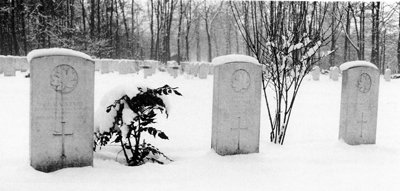
A visit to the Canadian cemetery is very instructive and inspiring, especially
for those who want to understand the insanity that every war really is.
On many stones
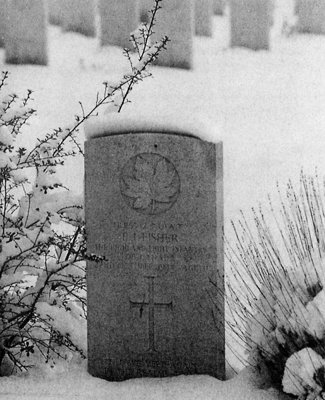
we read "A soldier of the Canadian army. Known unto God" or: "Three airmen.
Known unto God", or else: "A sailor of the 1939-1945 war. Known unto God".
And for a French soldier simply : "Inconnu" "Unknown".
A little further
the monotonous rows of gravestones are suddenly interrupted by three stones standing close
together. They turn out to be three members of the crew of a plane that was brought down
on Thursday 10 April 1941: Robert Hamilton, Jack Howel and Arthur Wickens. On the stone of
Lieutenant Edward Roberts we read his brother pilot David Roberts is reported missing
since 22 July 1942. The brother of Joseph Cromwell lost his life at sea near Dunkirk,
France. Known unto God...
We were intrigued to know why all these young Canadians crossed the ocean to liberate occupied Europe that suffered so much under the Nazi yoke. For many of them their departure was neither pleasant nor self-evident: "It was a sad day when you bade us good-bye", we read on the stone of William Starostic from Niagara Falls. And Earl and Elisabeth Haycock from Tillsonburg, Ontario who lost their son Walter on 16 October 1944 wrote "Our darling son Walter. We know you didn't wish to leave us, but we are always with you".
Maevis, the widow of Melville Spencer, from Winnipeg - Manitoba whose twenty year old husband died on Monday 9 October 1944 expressed her loss as follows: "To have, to hold, to part is the greatest sorrow of my heart". Carl Anderson from Lac du Bonnet, Manitoba who died on Friday 27 October 1944 was anxiously waved off by his parents and by his wife Betty when he left for Europe:
With a cheery smile
a wave of the hand
he has wandered into
an unknown land...
And how often we read:
I often think, I see his smile,
as he bade his last good-bye
and left his home for ever
in a distant land to die...
Even after the departure of their sonNorman, the family of James White still thought of the future. Alas in vain:
Of all we planned, dear son
you will never know
we lived, hoped,
prayed in vain
to see you safely home again.
Many Canadian volunteers saw themselves as modern crusaders who had to save from the godless Nazi tyranny not just Europe but their own country as well. Paul Brisebois of the Régiment de la Chaudière from Sainte Thérèse de Blainville (Quebec) joined up because he believed he would save the catholic faith and the French-Canadian race. Sergeant Lapointe of the Fusiliers Mont-Royal had gone from Quebec City "for the glory of God, the triumph of the Church, the honor of my family".
In Canada they were deservedly proud of the ultimate sacrifice of so many compatriots. The parents of Albert Richardson (Gilroy, Saskatchewan) expressed it briefly but to the point: "Well done, Bert, rest in peace". On the tombstone of private Vincent we read: "He has fought the good fight. Grant him, 0 Lord, the eternal peace". And it appears from the epitaph of Arthur Taylor that "he loved honour more than he feared death".
The reasons why they sacrificed their lives are very divers. Brian Butler from Sale (Cheshire, England) died because of his love for his fatherland:
Be England what she will
With all her faults
She is my country still
William Young from High Garrett (Essex) died for the same reason:
He died for his country
in a foreign land
but the memory of him
is in England
and air gunner Edward Dunford was also a real patriot:
For England he flew
he had no fears
we'lI never forget him
through the years
Norman Stoat was only 21 when he died on Wednesday 18 October 1944. On his grave we read that "he died the helpless to defend a faithfull soldier's noble end". And the parents of bombardier Alexander Angus from Aberdeen in Scotland were proud of the fact that their son had given his life for his friends: "Greater love hath no man than this that a man lay down his life for his friends..." Major Leonard Gass "died that we might live" and sergeant Alexander Clark died for the same reason:
He gave his life that others might live
in peace. What more has man to give?
So many of them gave their life for our freedom. "We gave our all for freedom's cause", we read on the stone of sergeant William Herrod. Obviously they hoped their sacrifice would not be in vain.
The spouse and parents of captain Clifford Haylett expressed this hope as follows:
"May his sacrifice help to bring
the peace and freedom for which he died".
Of course there were also the doubts. What was the sense of it all? Were the young lives of so many thousands of soldiers not sacrificed needlessly? Faith was the only way out for many, "there is always God". The parents of pilot Donald Stewart didn't understand the loss of their son but they thought "for God, everything has a meaning".
The mother of pilot Thomas Baston found solace in her faith in God: "I bless the years we had together and leave you safe with God". For many next of kin it was also God's will to have called back their son or husband. Norman Sharpe's wife wrote:
God called him home
it was his will
but in our hearts
we love him still
Yet many didn't understand why precisely their son had to die. On John Falla's stone there is just one word: "Destiny" and the parents of another hope: "Some day, we'll understand".
Now and again there also was bitterness, as for private Murray Smith: "That grief is common does not make one's own less bitter". For the parents of Hugh McColl there is not only God: "God has him in his keeping, we have him in our hearts".
Dominant is nevertheless the immense grief, the never abating pain because of the loss of what was most dear of all. For many it is not a final farewell but "only good night, beloved, not good-bye", as James and Maude Teeple write. And also the parents of Joseph Chapman hope: "Some day, dear son, we will meet you, never to part again". The wife of private Walter Coltman is convinced that she and her husband will meet again:
Love can never die
We have not said
the last word
when we have said good-bye
For many parents the loss of their son meant a long period of suffering. For instance Mr. and Mrs. Dorrington from New Glasgow (Nova Scotia) who lost their son Daniel:
When all is still and silent
and sleep forsakes my eyes
my thoughts are where
my dear son lies.
And the wife of Ferris McKee who remained behind with a daughter and a small son. She didn't forget her husband either: "To see your face, hold your hands and whisper: We love you". Here is how the parents of Adelard Martin express the pain of his loss:
Deep in our hearts
your memory is kept
we smile with the world
but never forget
Private Ivan McDonald will always be remembered by his relatives: "Not just today, but every day, in silence we remember". Indeed exactly like seargeant Bloomer:
Till memory fades
and life departs
you live forever
in our heart
For pilot William Thomas there was grief for what little life had given him, but there was also hope:
May the pleasures
you missed on life's journey
be yours in
God's garden of love
And for private Roy Wilmot it says:
To the rest of the world,
Roy was only one,
but all the world to us,
our only sun.
Very beautiful and moving is the epitaph of Jarvis McRae:
Not the only one, 't is true
others made that journey too
not returning with the rest
darling son, one of the best
We also get to know a thing or two about the fallen Canadians themselves. Ronald McLennan from Akali Lake (British Columbia) was "once happy, singing, smiling, kind, noble and brave". Clarence Tran who died on Saturday 7 October 1944 was "mild and gentle as he was brave, when the sweetest love of this life he gave".
And on the stone for pilot George Bevan who died on Wednesday 31 July 1940 we see: "In perfect honour, perfect truth, you trod the golden paths of youth". And about J. Singh from Medecine Hat (Alberta):
His life was earnest
his actions kind
a generous hand
and a active mind
Finally it is hoped that the son or husband "asleep in a strange land", will find eternal rest, as if he were in his fatherland (the tombstone of J.H. Richinski):
Bless, 0 Lord, our dear son
may Belgian soil
be unto thee
as that of thy native land
Hugo Notteboom.
