The Polish dead
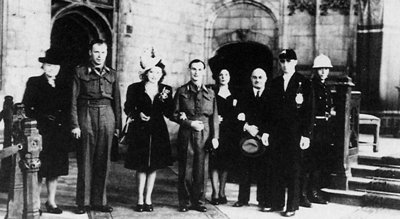
Sometimes the fraternization between Belgian civilians and allied soldiers
became more permanent: a Polish soldier married a girl from Ghent in Ghent's
city hall.
The Polish Tank Division
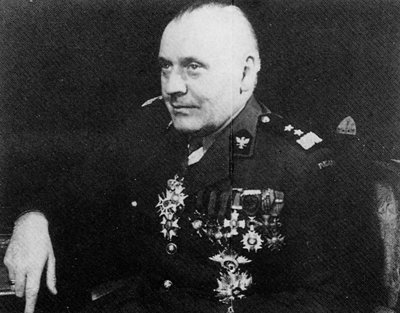
The hero of the Polish armoured Tank Division: general Stanislaw Maczek.
The general is now 102 years old and lives in Edinburgh in Scotland.
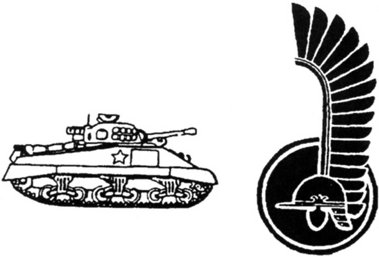
In the Battle of Vienna in 1683 the attacking Polish hussars had a headcover
with something like Indian feathers. They made a terrifying noice when they came to attack
in a frantic gallopade and the Hungarians were so intimidated they fled.
The emblem of the Polish Pantser Division is the stylized headcover of the 17th
Century Polish hussars.
In the Canadian cemetery 33 Polish soldiers were laid to rest. Like their Canadian comrades in arms they lost their lives for the liberation of our regions. These Poles were part of the 1st Polish Tank Division that was created in Great-Britain during the war and that was composed of Polish emigrants, soldiers shipped to Great-Britain and other volunteers. The division was under the command of General Stanislas Maczek who became famous as the commander of the "Black Brigade" when the Germans attacked Poland in September 1939. Especially in the south of Poland this brigade had put up a spectacular resistance.
The Polish Tank Division was part of the 21st Allied Army Corps of Montgomery and of the 1st Canadian Army under the command of General Crerar. After landing on the Normandy beaches heated battles were fought until about the end of August 1944. These cost the lives of 325 Poles and the loss of much equipment. From the end of August the Divsion started something like a victory march because in a few days they liberated Poperinge and Ypres (6 September), Tielt and Roeselare (7 September) and Aalter (8 September). On 11 September they drove into Ghent where they were received with as much enthusiasm as the 7th British Tank Divsion 5 days earlier. On 14 September they took Sing-Gillis-Waas and Stekene and on 20 September the region of Axel-Hulst was purged. The Polish Divsion had done a superb job.
The Poles in Ghent
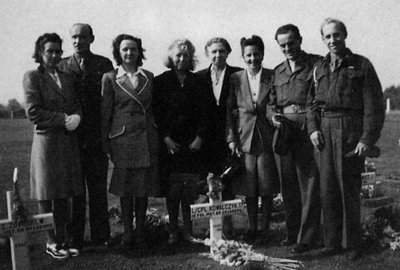
A small group of Free Poles poses in front of the grave of their compatriot
Tadeusz Kowalczyk who had fallen in battle on 9 September 1944 in
Aalter. They were Free Catholic Poles from Ghent, the so called
'Polish colony' who organized the first commemoration ceremony for their
compatriots.
Like the Canadians and the English the Polish soldiers, "jovial chaps, mostly volunteers who had got together from all over the globe to form their own divisions to pay with their own blood in the worldwide fight for right and freedom", could count on the sympathy of the people of Ghent. At the end of September 1944 the commanding officers of the Polish liberators received a golden commemoration medal from the city council and on 17 December 1944 in the Pacification Hall of the Ghent city hall a commemoration plaque donated to the city by the Polish liberators was unveiled. "In memory of 11 September 1944, the day of the arrival in Ghent of the 1st Polish Armoured Division, fighting for your freedom and ours", it says on the plaque. General Maczek thanked the people of Ghent for their friendly and generous reception and burgomaster Alfred Vander Stegen praised them for their dedication to our population and expressed the hope that they would soon be able to return to a free and independent fatherland.
In the "Damberd" on the "Koornmarkt" (Wheat Market) a Belgian-Polish club was founded that took to heart the fate of the Polish fighters and in a building in the Brabantdam a Polish-Belgian Friends Association came into being. It was open permanently for Polish soldiers, not only for recreation but also to give them information. An honorary comittee organized all sort of activities to get money for the benefit of Polish Soldiers. For instance a football match was organized between Polish soldiers and the players of La Gantoise Football Club (note of the translator: Ghent's First Division Football Club).
In March 1947 the Polish Division was disbanded. A lot of the soldiers decided to return to Poland while others opted for the free West. After the war an important group of Poles remained in Ghent and dreamed of a free fatherland that at long last became a reality only a few years ago.
Polish commemorations
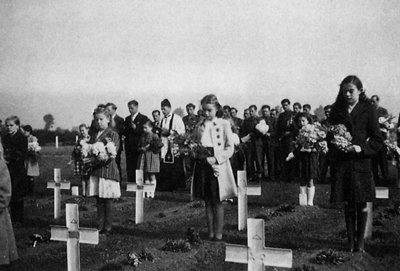
Exactly like for the Canadian commemoration ceremonies here too pupipls of the
schools of Adegem were present. Here we see a few girls ready to lay
flowers on the Polish graves. In the background we recognize some members
of the Adegem church choir, Urbain Haes the vicar and Polish veterans.
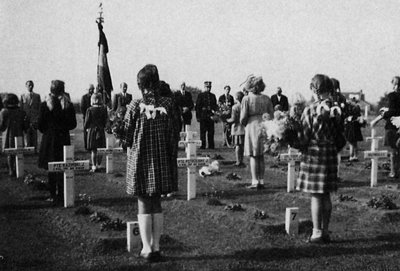
The commemoration of the Polish dead was traditionally organized in the
afternoon of All Saints Day. Only in the 1950s the 'official' Polish also
organized a commemoration and on none other than the same day but in the
morning.
On 24 August 1946 for the first time a Polish delegation came to visit the cemetery where their fallen comrades rest. Mrs le Clément de Saint-Marcq led the visitors about and made sure a reception was laid on in the town hall.
The commander of the Polish Tank Division, general Stanislas Maczek honored the cemetery several times with a visit. On Tuesday 7 November 1950 he was solemnly received by the Adegem town council and until the 1970s the general was a regular and well liked visitor in Adegem. In September 1964 at the occasion of the twentieth anniversary of the liberation of several Belgian cities by the Polish Armoured Division, general Maczek together with quite a lot of comrades in arms was solemnly received by burgomaster De Kesel after a visit to the Canadian cemetery. When in September 1972 a memorial stone was unveiled in Aalter to honor the fallen men of the Polish Tank Division, a delegation of a hundred Polish veterans led by their former commandant Maczek came to Adegem for another visit to their fallen comrades.
A good many memories were recounted about the battles the Poles fought around Ruiselede, Aalter, Sleidinge and of course also in Ghent. In the town hall burgomaster De Prest touched on the subject of the terror of war and the Polish veterans sang their nostalgic national anthem. Then for a while all was silent in the town hall.
At the occasion of the thousanth year of the existance of Poland in 1963 the Polish Veterans Association and Catholic Association of Ghent (Polska kolonia bylych wojskowych i stowarzyszenie katolickie w Gandawie) wanted to organize a few extra activities. First President R. Luczak and secretary B. Recki asked for some earth of the cemetery certified veritable earth from the cemetery. It would be stored for the time being in a shrine in the Polish House in Ghent, to be transferred later, "when the time would prove ripe to be interred in the grave of the unknow soldier in Warsaw." Then some wanted to organize an exhibition on the history of the Polish people for which the collaboration of the town council was asked.
The exhibition came to nothing. End 1962 Mr. Luczak had become president of the Polish Veterans and of the Polish Catholic Association because Stanislaw Szygowski, squadron leader and senior flying control officer of the 131st Polish Wing in 1944 - 1945 had resigned on 7 December 1962 because the above mentioned organizations had refused the flag with the white eagle on a red background with the inscription 1st Tank Division 131 P. Wing.
The Polish commemorations had traditionally taken place on All-Saints Day. In the morning the 'official' Poles (from the communist republic) were received and in the afternoon it was the turn of the 'free' Poles, the Poles in exile, especially member of the Polish colony in Ghent. In spite of the calls for fraternity and for peace politics clearly separated nations. The Adegem town council had to be very careful not to get the two delegations mixed up because the Catholic Poles from Ghent wanted to have nothing to do with their communist compatriots and vice versa.
Whatever the circumstances, both groups were always received equally cordially. The Polish ambassador was generally accompanied by a few military bigwigs and a delegation of Polish veterans. Again and again there was the conspicuous presence of a group of Polish children in tradional costume which, as everyone knows, is very colourful.
The Polish People's Republic showed its gratitude to the Adegem burgomasters De Prest and De Kesel, because in 1971 both received from the hands of the Ambassador the Polish Cross of Merit. The patriotic associations were not forgotten either: committee members Jules Van Deynze, Jozef De Keyser, Albert De Schepper, Albert Van Landschoot and constable Richard Spillebeen received the Polish medal of Appreciation because of their annual presence at the All-Saints Day ceremony.
The commemoration organized by the free Poles was from the very start attended without fail by canon Bressers whose merit for the free Poles was inestimable. Traditionally also Mr Luczak, Colonel Obrosky and other important free Poles were faithfully at their post. They too were always received in the Adegem town hall, where a reception was given and where the Golden Book was signed. It was always an occasion to renew the friendships that had come into being and there was always a very agreable atmosphere. "Vinum bonum laetificat cor hominis" we read in Psalm 104 and perhaps that is why during the 1987 reception the conductor's baton of "Value and Entertainment" was first seen in the hand of alderman Mrs. Van Cleemput-De Smet and then in the hand of Mr. Recki, president of the Polish veterans.
The interest in the Polish commemorations went down a little every year until this changed again in the 1980s. The offical delegation was more numerous again and the speeches had different content. In 1988 Minister Truszeczynski talked about a world where with respect for everyone's opinion peace, a right for everyone, was built up. Slowly but surely the political climate in Eastern Europe changed. It is to the credit of burgomaster Rotsart de Hertaing that he took the initiative to merge the two Polish commemorations. In 1989 the burgomaster alluded in his speech to the changes in the Easter Block and in 1990 there it was: the "official" and the "free" Poles came together in Adegem.
What none had ever dared to hope, Maldegem's burgomaster had been able to materialize. At first both groups had to get used to it. If this first joint commemoration ceremony was perhaps not the most impressive, it was in any case one of the most moving ever seen in the cemetery. They prayed together, they laid flower tributes on the Polish graves together and... they talked together. Ambassador Kulalowski who participated in the ceremony for the first time, the president of the free Poles, canon Bressers and many others found each other again as compatriots.
The next year all went off a whole lot less awkwardly. The important role of Poland in the process of democratisation in Eastern Europe was pointed out and when the Polish national anthem was played here and there a teardrop was wiped away. And from now on a commemoration ceremony full of atmosphere takes place every second Sunday after 2 November. In 1993 the burgomaster announced that "Maldegem planned to tighten the bonds of friendship in the first place on the cultural level."
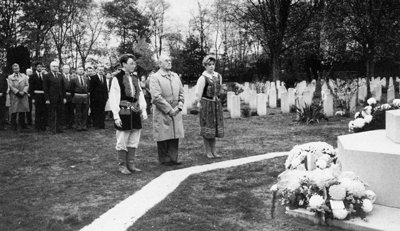
1 November 1989 : Julien Schoors, president of the "Adegemse Weggevoerden
en Werkweigeraars", (Adegem Deportees and those who refused to work)
honours a delegation of the official Poles.
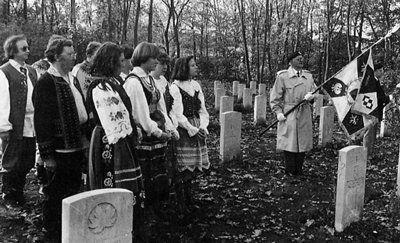
The commemoration of 1992: a small group of Poles in national costume and the
Polish ensign-bearer with the flag while the national anthem was sung.
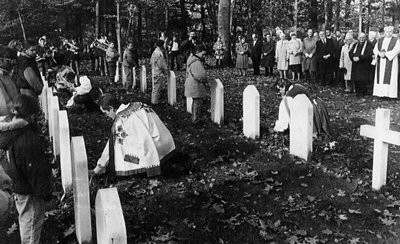
Flowers were laid by schoolchildren but also by the Polish men themselves.
In the background Mr. D'Havé, the vicar, canon Bressers and sexton Jozef De
Baets.
To Poland
Cultural exchanges between Poland and Belgium were mentioned already in 1974. To show his gratitude to the population of Adegem consul Marek Janikowski offered the youth of Adegem a really original present: 4 adolescents of Adegem were invited to spend a vacation of one month in Poland to get to know the people, their life and customs. No doubt the friendship between the consul and burgomaster De Prest had something to do with it. It is to the credit of Adegem's burgomaster that he found an original way of distributing these voyages and that he gave everyone a chance to win such a trip. He went to see the Adegem Culture Council and asked them to organize an essay competition with Poland as the subject.
An impartial jury without any members of the town council had to read the the essays and pick the best four. The President of the jury was literature connoisseur and chemist Achiel Van den Bunder, who enthuastically took care of the delicate task. As word got out about this competition the number of sponsors increased: there was also the prize of the burgomaster, a prize of the town council and a prize of the jury. On top of all that the Polish consul promised every participant a fine souvenir.
During an academic session and in the presence of consul Janikowski the names of the winners were announced: the 4 trips were won by Magda Boute, Veronique Geirnaert, Martin Rubens and Lieve De Spiegeleire. Janikowski was clearly very satisfied with the success of the competition and wished the 4 laureates a very happy trip to Poland from 1 to 30 July, all expenses paid by the embassy. The four left for Zaventem Airport in a mini-bus provided by the town council.
They lived through an unforgettable vacation in Poland and afterwards in the Adegem town hall the Polish consul was treated like a king. The fact that this exchange hit the bull's eye is further proven by the fact that to this day Magda Boute keeps contact with a family she got to know in Poland.
Important Polish visitors
President Jablonski and king Baldwin
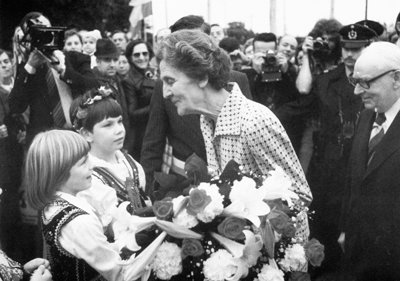
On his arrival Jablonski the Polis president and his wife were welcomed in
authentic Polish and showered with flowers by Vanessa Owczarek from Adegem all
dressed in traditional Polish attire. The president's wife was touched and
lavished praise on them.
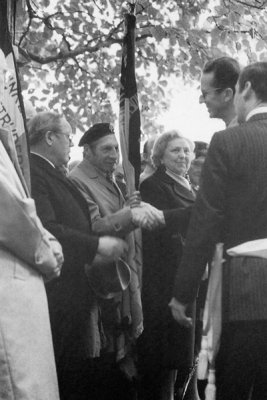
The king was very interested in those present in the cemetery: the veterans,
deportees and those who had refused to work. A moment Mr. Robert Aesaert
from Adegem will not forget in a hurry.
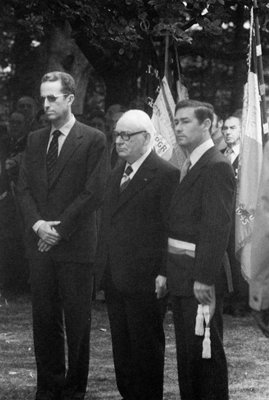
King Baldwin, president Jablonski and burgomaster Rotsart de Hertaing on the
graves of the Polish dead.
The rumour spread like wildfire through Adegem and Maldegem: king Baldwin would come to visit the Canadian cemetery with president Jablonski of Poland on Thursday 27 September 1979. The rehearsals with the school children on the Polish graves had given them away even though this was a private visit and the population was immediately very excited. Patriotic assocations, veterans, handicapped, hundreds of school children with Belgian and Polish flags in their hands and many dozens of others onlookers had gathered in the cemetery when the king and the president arrived.
The south western corner of the cemetery, where the Poles are buried, was kept unoccupied to allow the president a few moments to meditate on the graves of his fallen compatriots. The band of Guides took care of the musical accompaniment while 33 school children laid a bouquet on the graves of the fallen Polish men while the president looked on approvingly.
The king as well as the president spent a few moments with those present and President Jablonski was very agreably surprised to be introduced to so many Poles for whom Belgium had become a second fatherland but who couldn't forget their land of birth. A rather moving moment came when little Vanessa Owczarek, who lives in Adegm, offered a beautiful flower arrangement to Mrs. Jablonski and welcomed her in Polish. After they had signed the Golden Book and the Cemetery Register both heads of state left under loud acclaim of everyone.
Nor was this the only important visitor from Poland. End October 1979 Minister Janusz Wieczorek, during a trip around Europe, also came to visit the cemetery. He was welcomed in the Maldegem town hall and at the cemetery a group of Polish war veterans awaited him while pupils from the Adegem schools comprised the honour guard. General Skibinski, president of the Polish-Belgian Friendships Association in Warsaw was welcomed at the beginning of October 1980 by the magistrate of Maldegem.
A quite remarkable visitor was surely the Polish horseman who followed the entire path of the First Polish Tank Division and at the end of August arrived at the Adegem cemetery. The man went to see nearly all the Western European war cemeteries where Poles were interred and took a little earth with him from every cemetery to be kept in a church in Poland. His apparition in his very special uniform created quite a stir.
