Ceremonies and commemorations
until 1953
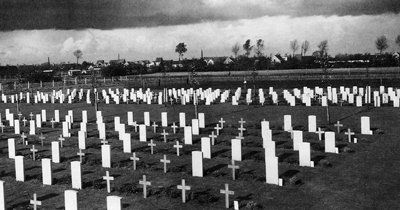
In 1948-1949 the zinc crosses were systematically replaced with tombstones.
This picture was taken from the Cross of Sacrifice toward the north.
In 1949 quite a few dignitaries paid a visit to the military cemetery. On 24 March it was the turn of Monseigneur Roy, the archbishop of Quebec who came to honor those buried here accompanied by Victor Doré, the Canadian ambassador and Monseigneur Calewaert, the bishop of Ghent. Other guests were chevalier Alex le Clément de Saint-Marcq, the husband of the lady well known to us and one of her brothers.
On 30 May two bishops came to visit: Mgr. M. O'Neill, archbishop of Regina and Mgr. Philip F. Pocock, bishop of Saskatoon. The VIPs were always received in the town hall where they signed the guest book.
The official commemoration ceremony almost didn't take place. The reason was to be found in the difficulties the association went through because of the resignation of Mrs. le Clément. Because of that the ceremony didn't take place on 3 July and was deferred to 2 November, All Souls' Day. It was a much more sober event compared to previous years. Not even all the members of the board of management of the Belgium-Canada Association were present.
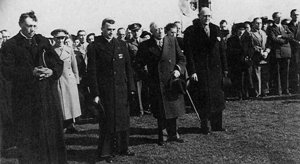
On 24 March 1949 Mgr. Maurice Roy, archbishop of Quebec came to visit the
cemetery.
He paid special attention to the graves of the men of the Régiment de la Chaudière.
We see Mgr. Calewaert, Mgr. Roy, ambassador Victor Doré, burgomaster Albert
De Kesel, Paul Migeon.
The 1950 Canada Day was also organized on 2 November. It was the first time Paul Migeon welcomed the VIPs as president. Ambassador Maurice Pope together with his wife led a sizable delegation of the Canadian Embassy. It was once again a grand commemoration ceremony and in the lovely town along the High Road from Brussels to Ostend the flags were flying at half-mast and many of the inhabitants attended the ceremony. New was the presence of the godmothers of the fallen and of the Protection Committee of the Canadian graves, which was presided over by Mrs. Martou. It was the intention of this committee to find a godmother for every grave in the cemetery. These godmothers would take care of the upkeep of the grave they had chosen. They would also as far as possible get in touch with the relatives in Canada. This initiative was a success because on 1 November 1950, the day before the official ceremony, the godmothers came together in the church and it was chock-a-block full.
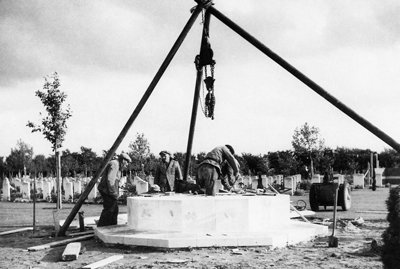
In March-April 1953 the Adegem War Cemetery got its definitive build. Except
for the monumental entrance the wooden cross was also replaced with a Cross of
Sacrifice in English Portland stone.
For the year 1950 we must also mention the visit on 20 October of officers and soldiers of the Canadian Navy. For some this turned into a memorable return to a friend who now lay buried here...
The next ceremony was held for the first time in September: 16 September 1951 became the start of a tradition that would only rarely wane. The Belgium-Canada Association had opted for the second Sunday of September precisely because this was the month when our region was liberated.
It cannot be denied that at long last the same formula for the ceremony began to appear worn out. Paul Migeon, the president, knew how to take the initiative and in 1952 for the first time he could welcome a representative of the king. The request had been introduced earlier but never granted because of the Royal Question. It was in fact the presence of the king himself they requested but the king had always sent a general as his representative. In 1952 the Royal Question was solved and therefore flight adjutant Lieutenant-General Piron came to Adegem on 14 September. It became once again a "firy" commemoration, not in the least because of the many dignitaries, more numerous than in previous years: ambassador Maurice Pope and his wife Simonne, who, by the way, was of Belgian nationality, Mgr. Calewaert, gouvernor Van den Bogaerde, colonel Van der Stichelen, the representative of the Minister of Defense, burgomasters from the whole region, Members of Parliament, etc. The Imperial War Graves Commission was represented by general Foster, who had liberated Brussels and who had been here on an earlier official visit. The presence of the band of the Navy also added to the atmosphere of ceremony.
In the cemetery itself the guard of honor was made up of Air Force men and Infantry soldiers. The minute of silence made quite an impression on many present, "l'immensité de la minute de silence apporta son message de confiance et d'espoir" the immensity of the minute of silence brought its own message of confidence and hope. The immense flower tribute looked endless. After the national anthems were played the VIPs were received in the town hall where friendships were renewed or tightened.
In the afternoon ambassador Lieutenant-General Pope together with his wife were invited for lunch in Ghent. He sincerely thanked the Belgium-Canada Association and praised Paul Migeon because of his "magnificent work". The ambassador also had words of praise for "the testimony of the humble local people, who in the bottom of their heart remained true to the glorious memory" ("le témoignage des humbles, des gens du terroir, restés fidèles, du fond du coeur, au glorieux souvenir").
On 2 November the "Honor the Canadian Military Cemeteries" Association came for a pilgrimage to Adegem. Under the direction of Mrs. Martou, a member of the board of the Belgium-Canada Association a special tribute was paid to the 39 fallen Canadian soldiers who belonged to the "Regiment de la Chaudiere".
Pilgrims who came to visit the cemetery at the end of 1952 or the beginning of 1953 immediately saw much would be changed because already during the ceremony of September 1952 the wooden cross stood partly dismantled. In March-April 1953 the cemetery received its definitive shape: the entrance, the Cross of Sacrifice and the rememberance stone were put up by Gaston Heene, a builder from Eeklo, according to plans by an English architect.
The monumental entrance was crowned with two pilasters of 5 meters; the seven meter high Cross of Sacrifice was entirely made of Portland Stone from England. The bronze sword on the cross weighs almost 100 pounds. At the end of the central corridor a memorial hall was built. There in three languages the visitor is reminded of how and why this cemetery had come here. In the center there is a small bronze cabinet where the Cemetery Register is kept. It is in this Register the visitor can write his message. One can also consult the official brochure that lists the names of all the men buried here. The whole is typically English and it was the intention of the architect to immediately attract the attention to the Cross of Sacrifice. Pictures of the ceremonies immediately make the intention of the architect clear: dignitaries come into the cemetery between two rows of soldiers with the public behind them. Automatically they go towards the Cross of Sacrifice and their attention is rivetted on it. This was perhaps forgotten during some of the ceremonies.
In 1953 13 September was the official Canada Day and it went off as usual. For the first time among the flower tributes there was a wreath of Flanders poppies. After the reception in the town hall the members of the Belgium-Canada and the Ambassador of Canada together with his staff drove to Knokke where they dined in the saloons of the St.-Georges Palace, decorated all over with Canadian flags. Ambassador Pope proved a very grateful guest because in a letter dated 22 September to President Migeon he speaks of the beautiful ceremonies and heaps praise on Paul Migeon and his association: "Allow me to tell you how proud you can be of your Belgium-Canada Association and the beautiful and moving ceremony that it organizes every year in Adegem. This ceremony is unique; everything is so well done and it always remains touchingly sober and natural." (" Permettez-moi de vous dire combien vous devez être fier de votre Association Belgique-Canada et de la belle et émouvante cérémonie qu'elle organise chaque année à Adegem. Cette cérémonie est unique; tout est si bien fait en restant toujours d'une simplicité et d'un naturel touchants.")
That was the last letter Ambassador Maurice Pope wrote because in December he was replaced with Charles Pierre Hébert, who had already lived in Belgium and "burned with the desire to see Belgium and its partner Luxembourg again and to taste the joy of bringing them even closer together."
